


Parents certainly want the best for their children, especially when it comes to education. Education does require a lot of money, but with these 4 strategies you can be one step better at planning for it.
How to Plan for Your Child’s Education Fund
1. Make a list of expenses related to education
There are a lot of expenses that are related to education, including monthly, semi-annual or maybe annual tuition fees (depending on the level of education and where your child is studying) and building fees.
In addition, you also need to plan for daily school-related needs, such as stationery, transportation and pocket money. There are also other non-daily needs, such as textbooks, shoes and bags.
To make it easier and you don’t forget anything, you can make a list of expenses related to your child’s education. One important tip, don't forget to also consider inflation not only for the cost of education but also the cost of daily needs.
2. Allocate the budget regularly
After knowing how much your child’s education costs, you can start allocating the budget. So it doesn’t seem like a lot of money, you can set aside money every month. Setting a saving target is also a good idea.
By setting a target, you know how long it will take to save money and how much money you have to set aside each month.
Given the importance of education funds, to avoid them being used for other purposes, budgeting can be done at the beginning of the month or immediately after payday.
3. Save money in a Saving Pocket
For hassle-free budgeting, you can use the Jago Pocket at Jago Syariah. Because setting aside money for education is a saving activity, the right pocket for you is the Saving Pocket.
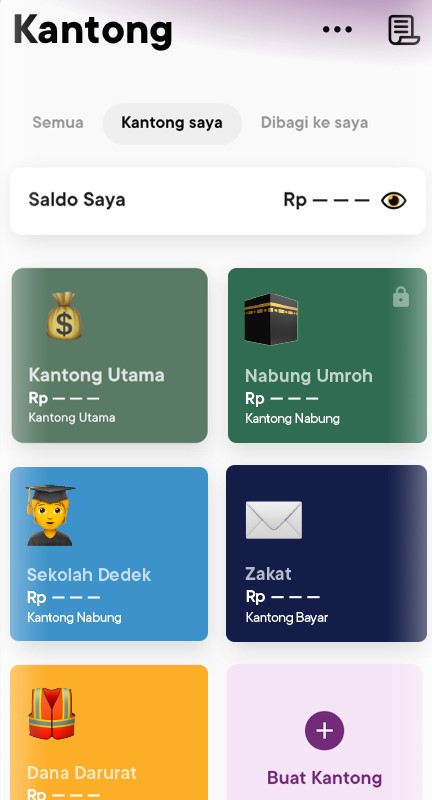
Practically, if you already have a Saving Pocket, you can set a saving target and activate the available automatic saving feature. In this way, savings can grow by itself and each day you are one step closer to achieving your financial goal, which is to have sufficient funds for your child's education. Every transaction is also recorded by Jago, so you can easily monitor it at any time.
4. Involve your spouse in managing finances
In married life, there are two people involved, husband and wife. Therefore, both must be equally responsible, including in financial management.
Certified financial planner Annisa Steviani recommends that each couple take the time to discuss financial planning. At this time, you and your spouse should also discuss how money should be managed, whether shared or held by the one who is more capable.
If you and your spouse have mutually agreed that only one person manages household finances, including education funds, then you can use the Saving Pocket as described above.
However, if you and your spouse agree to manage the household finances together, you can use a Shared Pocket, which is also available at Jago Syariah. Basically, the Shared Pocket is the Saving Pocket. The Saving Pocket will turn into a Shared Pocket when you invite someone to join.
With the Shared Pocket, you and your spouse can set aside money for your child's education from the Jago application on your own cellphone. The Shared Pocket also prioritizes transparency. You and your spouse can both monitor how money is used by accessing the transaction history.
For the sake of your child getting the best education, education funds need to be planned carefully. Jago Syariah is ready to accompany every step you take to get closer to achieving your goals.
No need to worry, the features in Jago Syariah are as complete as those in Jago conventional. However, with Jago Syariah, all your Jago Pockets have used the Wadi'ah principle. The Wadi'ah principle is a principle based on the Wadi'ah Yad Dhamanah akad, which is used for savings products and has the nature of deposit.
So when you save money at Jago Syariah, you entrust the money to the bank. After the money is received, Jago Syariah will manage the money according to sharia principles. And since the Wadi'ah Yad Dhamanah akad is a deposit, the bank does not promise any rewards. But, you can take your money whenever you want.
Move Child's Education Savings to Sharia Deposit Once It Has Accumulated Enough
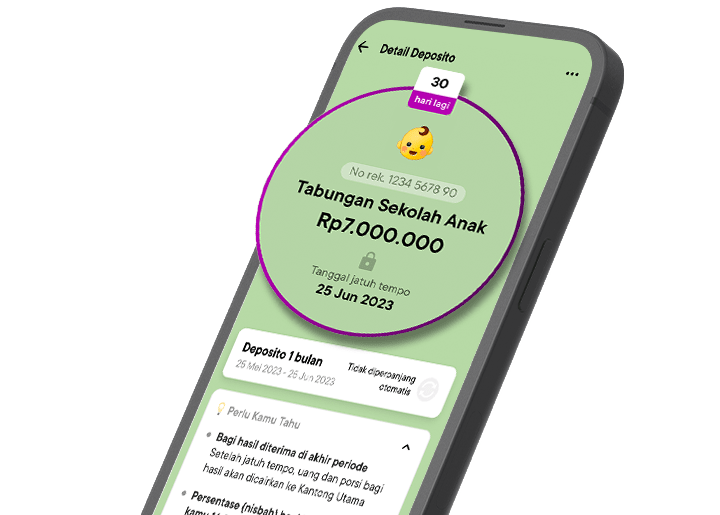
To protect your child's education savings from being used for purposes other than its intended use, especially once it has accumulated a large enough amount, you can move the funds to a Sharia Deposit.
Why the Sharia Deposit? Because by saving in a Sharia Deposit you can choose the period for saving money according to your needs. There is also an option to automatically extend the deposit after the maturity date, if the money won’t be used for your child's education needs soon.
Apart from that, by saving in a Sharia Deposit you can get a competitive profit sharing based on Mudharabah Muthlaqah akad that complies with sharia principles. The greater the funds saved, the greater the profit share.
Read all the benefits of opening a Sharia Deposit via the Jago application here.