


In the competitive business world, the temptation to constantly seek maximum profits can often lead to greed. Greed is not only morally detrimental, but it can also destroy a business in the long run. Unethical practices, impulsive decisions, and neglecting the well-being of others are just some of the negative impacts of greed. So, how can you shield yourself and your business from the clutches of this trait?
Greed in Islam: A Trait That Destroys Business Blessings
In Islamic teachings, greed is viewed as a highly reprehensible heart disease that must be avoided, including in business activities. As reported by the UIN Alauddin Makassar website, the essence of greed is an insatiable ambition to acquire more wealth, influence, or worldly pleasures.
In a business context, greed can manifest in various forms: hoarding goods to inflate prices, reducing product measurements or quality for greater profit, exploiting workers, or even engaging in explicitly forbidden practices.
The characteristic of greed is the opposite of qanaah (contentment). For a Muslim, avoiding greed in business is not just about ethics; it's an integral part of worship and an effort to achieve blessings in this world and salvation in the afterlife.
Qanaah: Key to Contentment and Blessings in Business
One of the answers lies in the concept of qanaah when running a business.
What exactly is qanaah?
Qanaah is an attitude of acceptance and feeling content with what one has obtained, without greed or excessiveness. This doesn't mean being passive or unwilling to grow; rather, it focuses on gratitude and blessings.
Examples of qanaah in a business context
In a business context, qanaah means:
- Valuing the process, not just the outcome: Understanding that profits gained are the result of hard work and divine permission, not solely personal ambition.
- Prioritizing quality and blessings: Prioritizing the quality of products or services and seeking blessings in every transaction, rather than merely chasing volume or instant profits.
- Avoiding harmful behavior: With qanaah, a business person will tend to avoid practices like monopoly, fraud, or exploitation for sole gain.
A business built on the foundation of qanaah will bring inner peace to its owner, as they won't be constantly driven by limitless ambition. Implementing qanaah in business isn't just about spirituality; it's also a long-term strategy for sustainability and a good reputation.
The Importance of Separating Personal and Business Finances
One of the most important steps to maintaining business health and preventing it from being influenced by personal greed is separating personal and business money.
Why is it necessary to separate personal and business money?
-
Preventing impulsive spending: Business money mixed with personal money is highly susceptible to being used for consumer needs or hobbies that have no relation to operations. Separating funds creates a boundary so that individual greed does not erode business capital.
-
Accuracy of financial reports: Separating accounts is the key to correctly managing business finances. With separate accounts, you can accurately calculate profit/loss, COGS (Cost of Goods Sold), and cash flow, ensuring expansion decisions are based on data, not on assumptions or desires.
-
Legality and Taxes: Fund separation demonstrates professionalism and simplifies tax matters and audits in the future.
How to Manage Business Finances with the Principle of Qanaah
-
Use separate accounts: Open an account specifically for the business. Never pay for personal expenses (such as children's school fees) using the business account.
-
Determine your own salary: The attitude of qanaah requires you to take a reasonable salary from the business, not take profits arbitrarily. Determine your salary, and only use that money for personal needs.
-
Separate capital and profit: Business profit must be separated from working capital. Profits should be allocated for business development, not spent entirely.
Separating and Managing Business and Personal Finances in the Digital Age with Jago Syariah: A Solution for Constant Contentment and Qanaah
The attitude of qanaah needs to be supported by good financial management that adheres to Sharia principles. This is where you can use Jago Syariah to manage your personal and business finances easily and practically, always staying ahead in line with Sharia.
Jago Syariah offers a digital banking solution that simplifies financial management for business owners based on Islamic principles. This helps to avoid wasteful spending and financial practices often driven by greed.
1. Dozens of Jago Syariah Pockets for business and personal financial management
One of the main keys to financial success, both personal and business, is a clear separation between the two. Often, business owners, including beginners and MSME owners, struggle to separate personal money from business capital. This leads to confusion, difficulty tracking profits, and even the risk of bankruptcy. However, with the Pocket feature from Jago Syariah, this problem can be easily and practically overcome.
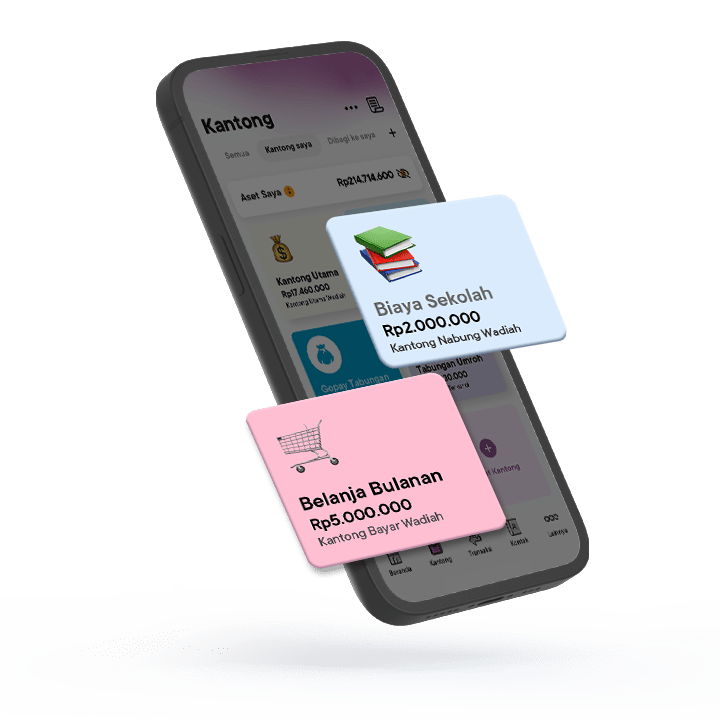
Imagine having dozens of accounts within one application, each with a specific purpose. You can create dedicated Pockets for all your personal needs: one for monthly household expenses, one for your child's education savings, another for a personal emergency fund, and even a Pocket for hobbies or vacations.
On the other hand, you can also create separate Pockets for every aspect of your business: one for business capital, one for operations (e.g., rent, employee salaries), one for raw material purchases, another for marketing funds, and of course, a dedicated Pocket for business profits. This way, you can see your business performance in real-time without it getting mixed up with personal expenses.
Every incoming and outgoing transaction can be directly allocated to the appropriate Pocket. For example, when there's income from sales, you can immediately move it to the "Business Income" Pocket, and from there, allocate it to "Business Capital," "Operations," or "Profit." Similarly, personal expenses can be paid directly from their allocated Pockets. This ease eliminates the need for complicated manual recording or confusing spreadsheets. You can monitor your personal and business financial health in real-time, right from your hand, without worrying about personal money being used for business or vice-versa.
The practicality of these dozens of Jago Syariah Pockets isn't just about separation; it's also about measurable financial discipline. With clear allocations for every purpose, you'll be wiser in spending money, avoid waste, and focus on priorities. This helps you plan your personal and business finances more thoroughly, ensuring every rupiah works according to its purpose, and most importantly, keeps you away from the temptation of mixing finances that could lead to problems.
2. Budget allocation for kindness with Jago Syariah Pockets and Jago Amal
In the business world, which is full of material temptations, greed and extravagance can destroy integrity and blessings. One antidote to this is the habit of giving through sadaqah and zakat.
By fulfilling these recommendations and obligations, a business person is encouraged to release a portion of their wealth, realizing that some of the sustenance received is not solely theirs, but also belongs to others.
You can easily allocate funds for zakat and sadaqah to different Pockets. From the budget already allocated for good deeds, you can then use Jago Amal to distribute zakat and sadaqah practically and transparently.
When you consistently set aside and distribute wealth easily through Jago Amal, it will directly train the soul to practice qanaah—feeling content and grateful for what you have, while also realizing that true happiness doesn't only lie in the accumulation of wealth, but also the ability to give.

Blessed Business, Peaceful Life
Greed is the main enemy of blessings and sustainability in business. By practicing qanaah as a life philosophy and supported by a financial management application like Jago Syariah, business owners can practically translate the values of qanaah into daily financial management.
As business people, let's build businesses that are not only materially profitable, but also rich in blessings, far from the clutches of greed. This is a step towards a more responsible, ethical business that brings peace to all.