




Talking about money with your partner often feels awkward. Yet, shifting the perspective from "our money" to "our shared future" is a crucial step toward building a strong, transparent relationship foundation.
Discussing investments with your partner isn’t just about deciding how much to set aside each month; it’s about aligning your vision for life, your dreams, and your strategy for handling potential future risks.
How to Start Discussing Investments with Your Partner Without the Awkwardness
The first step determines the success of your financial communication. To keep the conversation smooth and non-judgmental, here are several approaches you can use:
1. Pick the Right Moment and Setting
Avoid bringing up heavy topics when either of you is exhausted from work. Choose a relaxed time, such as over weekend coffee.
2. Focus on Dreams, Not Just the Numbers
Start with questions like, "What are our goals for the next five years?", such as buying a house, funding a wedding, or going on a dream vacation, then connect those goals to the required budget.
3. Be Completely Open About Financial Status
Transparency regarding assets, debts, and routine expenses is essential before moving on to investment strategies.
4. Understand Each Other's Risk Profiles
Some people are conservative, while others are aggressive. Recognize that these differences are normal and can complement each other.
Setting Financial Goals and Investment Strategies Together
Once you share a common understanding, it is time to map out your financial goals by timeline.
- Short-Term Goals (1–3 Years): Emergency funds, vacations, or a vehicle down payment. Low-risk investment instruments are highly recommended here.
- Long-Term Goals (Over 5 Years): Children's education funds, retirement, or home ownership. You can opt for instruments with higher yield potential.
Safe and Easy Investment Choices for Couples
For modern couples seeking convenience, combining mutual funds and stocks offers a balanced way to manage risk.
You can start investing in mutual funds and stocks through Bibit and Stockbit. With Bibit, you and your partner can select money market, bond, or equity mutual funds tailored to your risk profile and timeframe. Bibit's Robo-Advisor feature also helps beginners build automated portfolios.
Meanwhile, for long-term goals requiring higher asset growth, you can use Stockbit to invest directly in stocks.
Effortless Portfolio Tracking in App for Jago and Jago Syariah Users
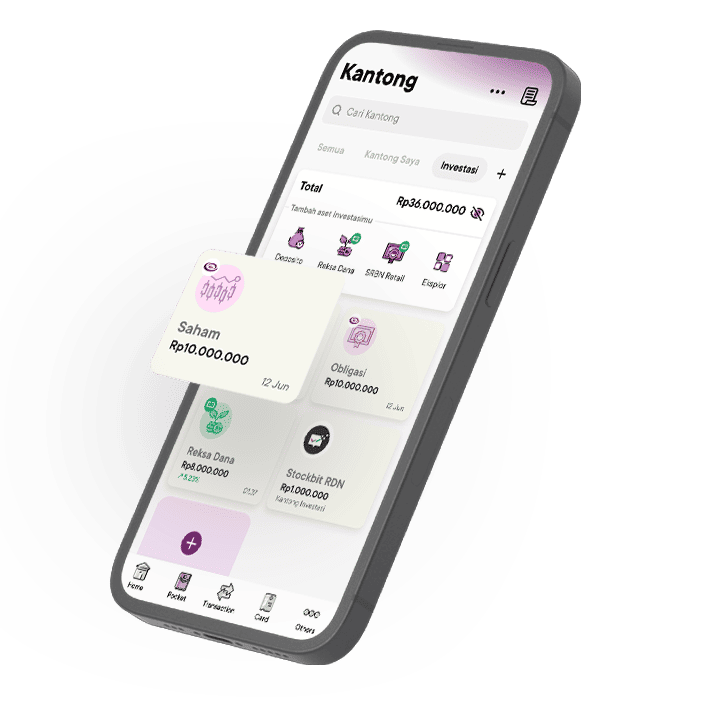
Managing your investments becomes far more practical when linked directly to an app that helps track your daily cash flow. There is no need to switch between multiple apps just to check your collective portfolio progress.
If you want to track your investment portfolio seamlessly, the Investment Portfolio tab provides a single consolidated view of all your assets. This feature connects directly to official KSEI data for stocks and bonds, while integrating smoothly with the Bibit and Stockbit ecosystems. You and your partner can monitor total asset values, from mutual funds to stocks, neatly categorized into dedicated Pockets.
FAQ About Couples' Financial Discussions
1. What if one partner has a history of consumer debt before marriage?
Address the debt openly first. Decide together whether it will be paid off using the debtor's personal income or partially assisted by the joint budget before allocating funds toward investments.
2. Should a couple's investment funds be combined in one account or kept separate?
By regulation, investment accounts are personal and tied to individual ID numbers (NIK). However, strategically, you can split roles, for example, one partner's account focuses on long-term stock investments, while the other's focuses on short-to-medium-term mutual funds.
3. What should be done if investments experience a loss and trigger conflict?
Revisit your initial agreement on risk tolerance. Evaluate together whether the drop is temporary due to market fluctuations or stems from a fundamental change in the chosen instrument. Avoid placing blame, and focus on future mitigation steps instead.